Description
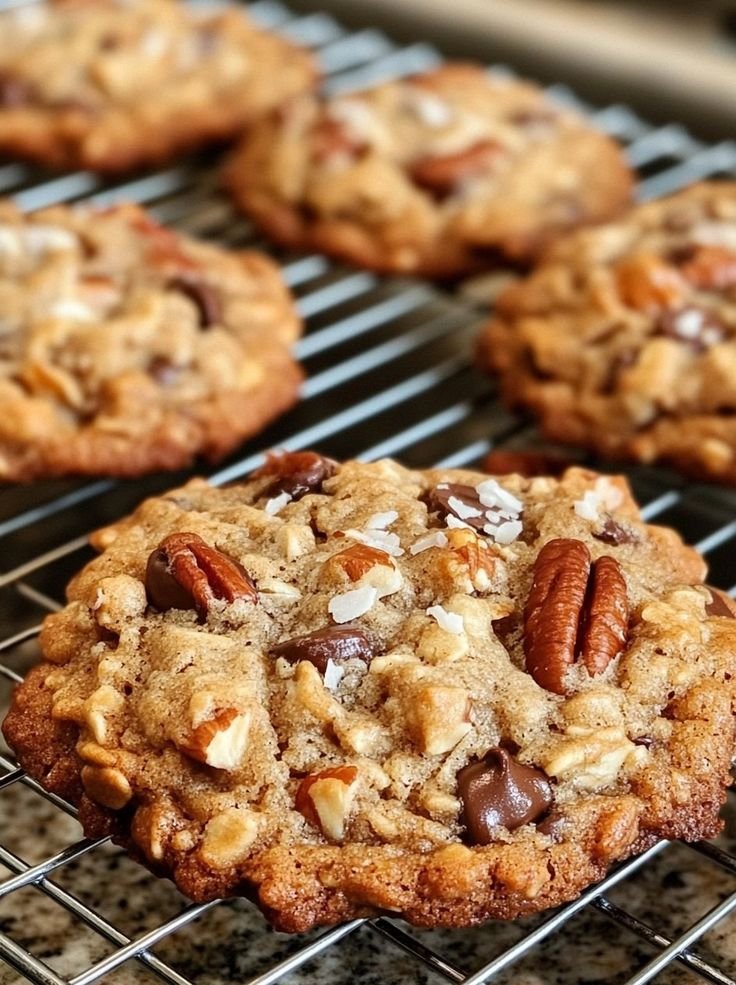
Cowboy cookies are the ultimate treat for anyone who loves a cookie packed with texture, flavor, and plenty of delicious mix-ins. These homemade cowboy cookies combine buttery brown sugar dough with hearty rolled oats, crunchy pecans, sweet chocolate chips, and shredded coconut for a rich, chewy center and beautifully golden edges. Every bite delivers a satisfying blend of sweetness, nuttiness, and chocolatey goodness.
This easy cowboy cookies recipe is perfect for bake sales, family gatherings, holiday cookie trays, or an afternoon treat with coffee. Although traditional cowboy cookies are not naturally low-carb or especially high in protein, they contain some protein from oats, eggs, and pecans. You can also adapt the recipe with higher-protein ingredients or lower-carbohydrate alternatives if they suit your dietary goals.
Short 3-Line Recipe Description
These homemade cowboy cookies are chewy, buttery, and loaded with oats, pecans, coconut, and chocolate chips.
Their golden edges and soft centers create the perfect balance of crunch, sweetness, and rich flavor.
Easy to prepare and perfect for sharing, these classic cookies make a delicious addition to any dessert table.
Can Cowboy Cookies Support Weight Loss Goals?
Cowboy cookies can fit into a weight-management eating plan when enjoyed in appropriate portions alongside balanced meals. Their oats, eggs, and pecans contribute some protein, while oats and nuts also provide fiber and fats that can help make a snack more satisfying.
However, traditional cowboy cookies contain butter, sugar, flour, and chocolate chips, making them relatively calorie-dense compared with many fruit-based snacks. They are not a high-protein weight-loss food on their own, but one cookie can be enjoyed as an occasional treat without abandoning an overall balanced eating pattern.
For a lighter variation, make smaller cookies, reduce the added sugar slightly, and measure the chocolate chips carefully. You can also replace some of the flour with a suitable higher-protein ingredient, although this may change the cookies’ texture and flavor.
Do Cowboy Cookies Fit a High-Protein Lifestyle?
Traditional cowboy cookies can contribute a small amount of protein through eggs, oats, pecans, and chocolate chips.
However, their main ingredients are flour, butter, and sugar, so they are better classified as a dessert than a high-protein snack.
A standard cookie may contain approximately 3–4 grams of protein and around 15–20 grams of net carbohydrates, depending on its size and ingredients.
They are not naturally low-carb or keto-friendly because regular flour, oats, and sugar contribute substantial carbohydrates.
For a higher-protein variation, experiment with partial protein-powder substitution and smaller portions, while recalculating the nutrition values.
My Personal Experience
- A wonderfully chewy texture: The combination of rolled oats and brown sugar creates cookies with soft centers and lightly crisp edges.
Pecans add a pleasant crunch that contrasts beautifully with the chewy dough. - Rich chocolate in every bite: Semi-sweet chocolate chips melt slightly during baking, creating little pockets of chocolate throughout the cookies.
Their sweetness balances the nutty flavor of the pecans and the mild taste of coconut. - A satisfying mix of flavors: Brown sugar gives the cookies a caramel-like depth, while vanilla enhances the buttery aroma.
Oats, coconut, and pecans make each bite more interesting than a plain chocolate chip cookie. - Easy to customize: You can use walnuts instead of pecans or choose dark chocolate chips for a deeper chocolate flavor.
These simple swaps let you adapt the recipe without changing the overall cowboy-cookie character. - Perfect for sharing: The dough is easy to portion into individual cookies, making it convenient for parties, lunchboxes, and family gatherings.
The baked cookies also store well, so you can prepare a batch ahead of time.
Perfect For
- Homemade dessert recipes: Cowboy cookies are ideal when you want a classic, generously filled cookie with several textures.
- Afternoon snacks: Enjoy one cookie with tea, coffee, or a glass of milk.
- Holiday baking: Their golden color and abundant mix-ins make them a welcome addition to cookie platters.
- Bake sales and potlucks: The recipe produces individual portions that are easy to transport and share.
- Family baking days: Children and adults can help measure ingredients, fold in the chocolate chips, and portion the dough.
- Meal-prep treats: Bake a batch and freeze some cookies for convenient future desserts.
- Higher-protein dessert experiments: A modified version can incorporate protein powder or other protein-rich ingredients, although the classic recipe is not especially high in protein.
- Special occasions: Serve them at birthdays, picnics, casual gatherings, or weekend get-togethers.
Traditional cowboy cookies are not suitable as a naturally low-carb or keto dessert, and they are better suited to occasional treats than as a high-protein breakfast.
Why You’ll Love This Recipe
- Loaded with delicious mix-ins: Oats, pecans, coconut, and chocolate chips give every cookie a combination of flavors and textures.
You get a little crunch, chewiness, and chocolate in every bite. - Golden edges and soft centers: Properly measured ingredients and careful baking create cookies that are lightly crisp outside and tender inside.
Letting them rest on the baking sheet helps the centers finish setting. - Simple pantry ingredients: Most of the ingredients are common baking staples, so you can prepare the dough without specialty equipment.
Measuring everything before mixing makes the process easier and more consistent. - Easy to customize: Swap pecans for walnuts or use a different chocolate-chip variety to suit your preferences.
You can also adjust the amount of coconut or chocolate without changing the basic method. - Great for make-ahead baking: The dough can be chilled before baking, and the finished cookies freeze well.
This makes it easy to have homemade treats ready for unexpected guests. - Perfect for sharing: The recipe makes approximately 24 cookies, so it works well for parties, family gatherings, or gifting.
Consistent dough portions help the cookies bake evenly and look attractive.
Common Mistakes to Avoid
- Using melted butter that is too hot: Hot butter can change the dough’s consistency and cause the cookies to spread excessively. Let melted butter cool before mixing, or use softened butter as directed.
- Overmixing after adding flour: Excessive mixing can develop too much gluten and make the cookies tough. Mix only until the flour disappears and the ingredients are evenly distributed.
- Skipping the spacing between cookies: Cowboy-cookie dough spreads as the butter melts in the oven. Leave about 2 inches (5 cm) between dough portions to prevent them from merging.
- Overbaking the cookies: The centers may look slightly soft when the cookies are ready to come out. Remove them when the edges are golden and allow them to finish setting on the hot baking sheet.
Required Equipment
- Large mixing bowl — provides enough room to combine the wet ingredients and dry ingredients without spilling.
- Electric hand mixer or stand mixer — creams the butter and sugars evenly for a consistent cookie texture.
- Measuring cups and spoons or kitchen scale — helps maintain accurate ingredient ratios and consistent cookie sizes.
- Whisk — distributes the flour, baking soda, and salt evenly before they are added to the dough.
- Rubber spatula or wooden spoon — folds in the oats, pecans, coconut, and chocolate chips without overmixing.
- Baking sheets — provide a flat surface for evenly shaped cookies.
- Parchment paper or silicone baking mats — reduce sticking and make cleanup easier.
- Cookie scoop or tablespoon — portions the dough evenly so the cookies bake at a similar rate.
- Wire cooling rack — allows steam to escape and helps the cookies cool without becoming soggy underneath.
Storage Instructions
Room temperature: Once completely cool, place the cookies in an airtight container and store them in a cool, dry place for approximately 4–5 days. Separate layers with parchment paper to prevent sticking.
Refrigerator: Refrigeration is generally unnecessary for these traditional cookies. If your kitchen is particularly warm, an airtight container in the refrigerator can help preserve the chocolate and butter, although the cookies may become firmer. Allow them to return to room temperature before serving.
Freezer: Freeze fully cooled cookies in a freezer-safe airtight container or zip-top freezer bag for up to 2–3 months for best quality. Place parchment paper between layers to protect the cookies from sticking or breaking.
Freezing cookie dough: Portion the dough into individual balls and freeze them on a lined tray. Once firm, transfer them to a freezer-safe bag and freeze for up to 2–3 months. Bake from frozen, adding a few minutes to the baking time and checking for golden edges.
Reheating: Warm a cookie in the microwave for approximately 8–12 seconds for a softer texture, or heat it in a preheated oven at 300°F (150°C) for 3–5 minutes for lightly crisp edges.
Nutrition tip: Portioning cookies before storing them makes it easier to keep track of serving sizes. Storage preserves freshness, but it does not increase the cookies’ protein content.
Recipe Details
- Preparation Time: 15 minutes
- Cooking Time: 10–13 minutes per batch
- Total Time: Approximately 35–40 minutes, depending on the number of batches
- Servings: 24 cookies
- Best Season for This Recipe: All-season, especially autumn and winter
- Total Calories per Serving: Approximately 200 calories per cookie
Calories are approximate and based on 24 similarly sized cookies. Actual values vary with ingredient brands, cookie size, and the amount of chocolate, nuts, and coconut used.
Ingredients
Makes approximately 24 cookies.
Wet Ingredients
- 1/2 cup (113 g) unsalted butter, softened
- 3/4 cup (150 g) packed light brown sugar
- 1/2 cup (100 g) granulated sugar
- 2 large eggs, at room temperature
- 2 teaspoons vanilla extract
Dry Ingredients
- 1 1/2 cups (190 g) all-purpose flour, spooned and leveled
- 1 cup (90 g) old-fashioned rolled oats
- 1 teaspoon baking soda
- 1/2 teaspoon baking powder
- 1/2 teaspoon salt
Cowboy Cookie Mix-Ins
- 1 cup (170 g) semi-sweet chocolate chips
- 3/4 cup (75 g) chopped pecans
- 3/4 cup (60 g) unsweetened shredded coconut
Ingredient Notes
- Butter: Use softened butter, not melted, for the creaming method in this recipe. If using salted butter, reduce the added salt slightly.
- Brown sugar: Packed brown sugar adds moisture and a caramel-like flavor that helps produce chewy cookies.
- Rolled oats: Old-fashioned oats provide a hearty texture. Instant oats may produce a softer cookie.
- Pecans: Chop the nuts into small pieces so they distribute evenly throughout the dough. Walnuts are a suitable alternative.
- Coconut: Unsweetened shredded coconut balances the sweetness of the chocolate and sugar.
- Chocolate chips: Semi-sweet chocolate offers a balanced sweetness. Dark chocolate chips can be substituted.
- Eggs: Room-temperature eggs blend more easily with the creamed butter and sugars.
Directions
Step 1: Preheat the oven — 5 minutes
Preheat the oven to 350°F (175°C). Line two baking sheets with parchment paper or silicone baking mats.
Position an oven rack in the center so the cookies bake evenly without the bottoms browning too quickly.
Step 2: Cream the butter and sugars — 2–3 minutes
Place the softened butter, brown sugar, and granulated sugar in a large mixing bowl.
Using an electric mixer on medium speed, beat for 2–3 minutes until the mixture looks lighter, fluffy, and evenly combined.
Scrape down the sides of the bowl as needed. Avoid using butter that is greasy or partially melted, as this can cause excessive spreading.
Step 3: Add the eggs and vanilla — 1–2 minutes
Add the eggs one at a time, beating on medium-low speed after each addition until incorporated.
Mix in the vanilla extract. The mixture should look creamy and cohesive, although a slight change in texture is normal.
Step 4: Combine the dry ingredients — 1 minute
In a separate bowl, whisk together the flour, rolled oats, baking soda, baking powder, and salt.
Add the dry mixture to the wet ingredients in two additions, mixing on low speed until just combined.
Stop as soon as no large pockets of dry flour remain. Overmixing can make the cookies less tender.
Step 5: Fold in the mix-ins — 1–2 minutes
Using a spatula, fold in the chocolate chips, chopped pecans, and shredded coconut.
Stir until the mix-ins are evenly distributed throughout the dough. The dough should be thick and chunky, with visible oats, nuts, coconut, and chocolate.
If the dough feels unusually soft or sticky, refrigerate it for 15–20 minutes before baking to help control spreading.
Step 6: Portion the dough — 2–3 minutes
Scoop approximately 2 tablespoons of dough per cookie and place the portions on the prepared baking sheets.
Leave about 2 inches (5 cm) between cookies to allow for spreading. Gently press down on any unusually tall dough mounds if you prefer a more even shape.
For consistent baking, use approximately the same amount of dough for every cookie.
Step 7: Bake the cookies — 10–13 minutes
Bake one tray at a time on the center rack at 350°F (175°C) for approximately 10–13 minutes.
Look for golden-brown edges and centers that appear slightly soft but no longer look wet. The cookies will continue setting as they cool.
Rotate the tray halfway through baking if your oven has noticeable hot spots. Avoid waiting for the centers to become completely firm in the oven, or the cookies may turn dry.
Step 8: Cool and serve — 10 minutes
Remove the baking sheet from the oven and allow the cookies to rest on the tray for 5 minutes.
Transfer them carefully to a wire rack and cool for another 5 minutes or longer. The edges will become firmer while the centers retain a chewy texture.
Serve with coffee, tea, or milk, or allow the cookies to cool completely before storing them in an airtight container.
High-protein baking tip: Traditional cowboy cookies provide only a modest amount of protein per cookie. If you experiment with protein powder, replace only a small portion of the flour initially and adjust the moisture as needed, because too much powder can make the cookies dry or crumbly.
Nutrition Facts (Per Serving – Approximate)
Estimated per cookie, assuming the recipe produces 24 cookies.
- Calories: 200 kcal
- Total Fat: 10 g
- Cholesterol: 25 mg
- Sodium: 125 mg
- Potassium: 90 mg
- Total Carbohydrates: 27 g
- Fiber: 2 g
- Net Carbs: 25 g
- Sugars: 17 g
- Protein: 3 g
- Calcium: 20 mg
These figures are estimates based on standard ingredient nutrition data and rounded serving sizes. Actual values will vary according to the specific butter, chocolate chips, nuts, coconut, and cookie weights. Net carbohydrates are calculated by subtracting fiber from total carbohydrates.
Notes
- Storage: Keep completely cooled cookies in an airtight container at room temperature for 4–5 days or freeze them for up to 2–3 months for best quality.
- Reheating: Microwave for 8–12 seconds for a soft cookie or warm in a 300°F (150°C) oven for 3–5 minutes.
- Allergy notes: This recipe contains wheat, eggs, milk, and tree nuts, and may contain additional allergens depending on the chocolate and coconut products used. Check labels carefully.
- Nut-free variation: Omit the pecans and replace them with extra oats or additional chocolate chips, recognizing that the nutrition will change.
- Flavor boost: Toast the pecans lightly before adding them to the dough for a deeper, nuttier flavor; cool completely before mixing.
- Chewier cookies: Use the specified brown sugar, avoid overbaking, and allow the cookies to finish setting on the hot baking sheet.
- Crispier cookies: Flatten the dough portions slightly and bake toward the upper end of the suggested time, watching the edges carefully.
- Higher-protein variation: Use a modest amount of protein powder in place of some flour and test a small batch first. The result will differ from the traditional recipe and may need additional moisture.
- Serving suggestion: Enjoy one cookie as a dessert or snack alongside Greek yogurt or a glass of milk for additional protein.
Frequently Asked Questions
1. Why are they called cowboy cookies?
Cowboy cookies are a hearty style of American cookie traditionally associated with generous additions such as oats, nuts, coconut, and chocolate chips.
2. Can I make cowboy cookies without pecans?
Yes, you can omit the pecans or replace them with walnuts, sunflower seeds, or additional oats, depending on your preferences and allergy needs.
3. Why did my cowboy cookies spread too much?
Cookies may spread excessively if the butter is too warm, the dough is overly soft, or the baking sheet is still hot from a previous batch.
4. Can I freeze cowboy cookie dough?
Yes, portion the dough into balls, freeze until firm, and store in a freezer-safe bag for up to 2–3 months for best quality.
5. Are cowboy cookies high in protein?
Traditional cowboy cookies provide a small amount of protein from eggs, oats, and pecans, but they are primarily a sweet baked dessert rather than a high-protein food.
6. How do I keep cowboy cookies soft and chewy?
Measure the flour accurately, use the specified brown sugar, avoid overbaking, and store the cooled cookies in an airtight container.